I have what I like to call a unicorn background in accessibility.
Accessibility cannot be fully understood through documentation alone. As a blind designer who depends on assistive technology 24/7, I bring lived experience to the work—because true accessibility is not defined by guidelines, it is defined by whether real people can actually use your product.
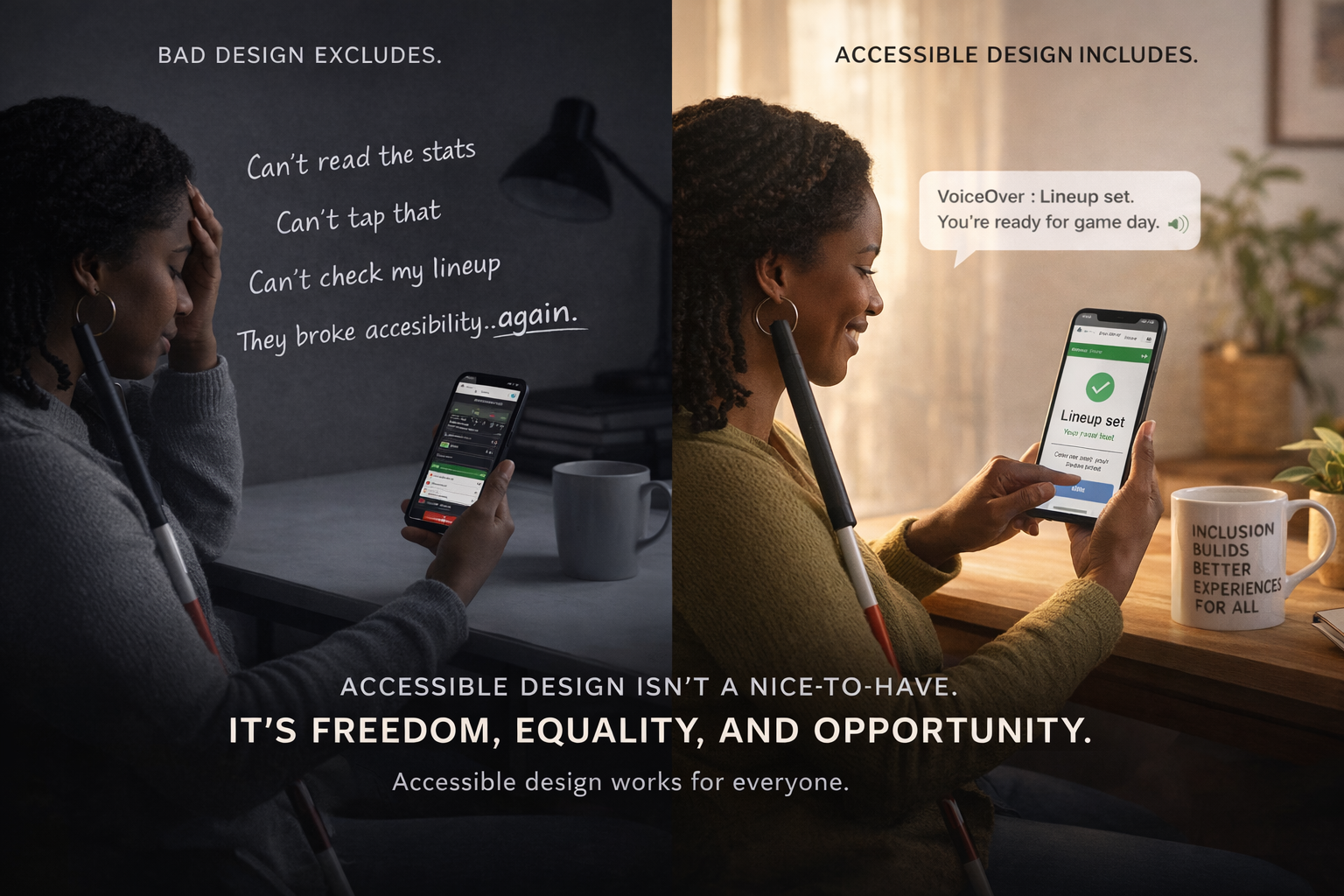
I also understand sports. I understand fantasy sports and Sports Gambling. I understand the emotional connection fans have to stats, scores, alerts, drafts, waivers, lineup changes, live game experiences, and second-screen engagement. And I understand what happens when those experiences are not accessible: fans with disabilities get left out of the game.
For years, I have worked at the intersection of accessibility and sports, most notably through my work supporting Yahoo Sports and Yahoo Fantasy Sports, where I helped push accessibility earlier into the product lifecycle instead of treating it like a cleanup project after launch. That shift matters. At Yahoo, I worked with design, product, and engineering teams to help build accessibility into planning, design reviews, testing, and release readiness. I supported launches like Yahoo Fantasy “28 Days of Fantasy,” contributed to the accessibility of Yahoo Fantasy Guillotine Leagues, and helped improve access to sports data through Yahoo’s first fully screen-reader-accessible sports box scores. I also brought that same lens to consulting work with sports and fantasy brands outside Yahoo.
What I have seen across the industry is this: sports, fantasy sports, and sports gambling have historically treated accessibility as optional. In reality, it is business critical.
The disability market is not niche. It is enormous. The Return on Disability Group’s 2024 report says people with disabilities in the United States control $1.3 trillion in annual disposable income, and that the disability market, when you include friends and family, represents $18.3 trillion globally. The World Economic Forum and Valuable 500 have similarly framed disability inclusion as an approximately $18 trillion business opportunity. So when a sports brand, sportsbook, or fantasy platform ships inaccessible experiences, it is not just failing a compliance test. It is turning away an audience with real spending power, real loyalty, and real influence over household purchasing decisions. (rod-group.com)
And yet the industry still behaves as if disabled fans are an afterthought.
Ask blind users how many sports apps are truly seamless with VoiceOver or TalkBack. Ask disabled fans how many major sports sites let them independently browse stats, set lineups, place wagers, manage account settings, complete deposits, verify promotions, or follow live action without friction. Some progress has absolutely been made, but the industry as a whole is still far from delivering fully accessible experiences. The fact that accessibility disputes and lawsuits continue to hit digital sports properties should be a wake-up call. In 2025 alone, more than 4,000 ADA lawsuits related to digital properties were filed, according to UsableNet’s reporting on 2024 trends and the continuing surge in filings. DraftKings was hit with another lawsuit in 2025 alleging that blind users were blocked from accessing its fantasy sports and gambling services through its website. (UsableNet Blog)
This is not new.
Major League Baseball reached a landmark accessibility agreement years ago covering mlb.com and all 30 team sites, followed by a later agreement for the MLB mobile app. However, in 2026, fans with disabilities still encounter meaningful barriers across both platforms—highlighting the gap between legal compliance and truly usable, inclusive experiences.
That history matters because it proves this industry has known about accessibility issues for years—and still has not fully solved them. It is a clear example of how legal agreements and stated commitments can fall short without sustained execution and accountability. (Equal Entry)
The companies that still do not get it often view accessibility as a cost center. That is backwards. Accessibility done early saves money. It reduces rework. It reduces legal risk. It improves design quality. It improves usability for everyone. It makes product teams sharper. And it prevents the all-too-common scenario where a company launches a shiny new feature, only to discover too late that disabled users cannot navigate key flows, complete transactions, or consume live content. Fixing accessibility at the design stage is always cheaper than retrofitting it after engineering, QA, legal review, customer complaints, legal action or forced mediation, and public embarrassment.
This is exactly why “shift left” accessibility matters. The best accessibility strategy is not simply automated testing, or a last-minute audit. It is a design and product strategy. It means involving accessibility experts before code is shipped. It means testing with real disabled users, not just automated tools. It means making designers, PMs, and engineers fluent enough in accessibility that inclusive thinking becomes part of the product culture. That is the model I helped drive in sports and fantasy work, and it is the model this industry needs now more than ever.
The urgency is only increasing because Europe has changed the game.
The European Accessibility Act became applicable on June 28, 2025. The European Commission says the law covers key categories including e-commerce and is intended to remove barriers created by fragmented national rules while creating more market opportunities for accessible products and services. Government guidance in Europe makes clear that websites and apps selling products or services to consumers must meet accessibility requirements, including around information, login, signing, and payments. In other words, if a company wants to keep doing digital business in Europe, accessibility can no longer be treated as a nice-to-have. (AccessibleEU)
For sports gambling and fantasy operators, that should set off alarms. The EAA does not call out gambling by name in the European Commission summary, but because it covers e-commerce and digital consumer services, legal analysts have already been warning that online gambling platforms may fall within scope when they conclude consumer contracts through websites and mobile apps. That means the risk is not theoretical. It is here. (European Commission)
And this is where global sports expansion becomes part of the accessibility conversation.
The NFL is actively expanding its global footprint. In 2026, Paris will host its first regular-season NFL game, and the league has also expanded its Global Markets Program to 22 international markets. As the NFL pushes deeper into Europe and beyond, fantasy sports companies, media partners, sportsbook operators, and engagement platforms are going to follow the audience. Global growth sounds exciting in boardrooms, but it also means global accessibility expectations, global compliance exposure, and global reputational risk. A company cannot credibly say it wants worldwide fans while continuing to ship products that many disabled users cannot independently use. (NFL Football Operations)
Will Europe’s accessibility laws eventually influence the United States even more directly? I believe so. Not because the U.S. will simply copy the EAA line for line, but because global companies rarely want one accessibility standard for Europe and a weaker one everywhere else. Regulation, litigation, procurement standards, and consumer expectations tend to move markets together. Europe is raising the Ceiling. The companies that move now will be better positioned not just for compliance, but for innovation, market expansion, and brand trust. That is an inference based on where the market and legal pressure are heading, but it is a pretty obvious one. (European Commission)
The sports industry has a choice.
It can continue treating accessibility as a legal problem to contain after a complaint, a lawsuit, or a failed launch. Or it can finally recognize accessibility for what it is: product strategy, market strategy, and growth strategy.
Disabled fans love sports. We play fantasy. We follow stats obsessively. We consume highlights. We wager. We subscribe. We buy tickets. We buy merch. We are not asking for special treatment. We are asking for equal access to the same experiences everyone else gets.
The companies that understand that now will win.
And the ones that do not are going to keep leaving money on the table, inviting legal risk, and building products for a smaller audience than they think.
If your company is serious about building accessible sports, fantasy sports, or betting experiences from the ground up, this is the moment to act. Not after another lawsuit. Not after another inaccessible launch.
Accessibility Isn’t Broken by Accident—It’s Broken by Design